Every commercial building in the UK needs a plan for fighting a fire in its early stages. A fire extinguisher on the wall is only part of that plan. Someone has to be legally accountable for it and someone has to know how to use it safely.
So who is responsible for using a fire extinguisher in a commercial setting? The short answer is that the law places the duty on the business (the Responsible Person) while the people trained by that business are the ones expected to pick up an extinguisher when it is safe to do so.
In this guide we explain who holds which responsibilities, the different fire extinguisher types and colours, what a fire extinguisher class means and why the layout of your workspace has a direct impact on where your fire extinguishers should go.
Who is legally responsible for fire extinguishers in a commercial building?
In England and Wales, fire safety in non-domestic premises is governed by the Regulatory Reform (Fire Safety) Order 2005, usually called the Fire Safety Order. It applies to offices, shops, factories, warehouses, schools and almost every other workplace. Scotland follows similar duties under its own legislation.
The Order names a Responsible Person. This is usually the employer. It can also be the owner, landlord or facilities manager who controls the premises. The Responsible Person must:
- carry out and regularly review a fire risk assessment
- provide suitable firefighting equipment, including the right type and number of fire extinguishers
- keep that equipment maintained and in working order
- give staff adequate fire safety training when they start and at regular intervals afterwards
- appoint competent people, such as fire wardens or marshals, to help put fire safety measures in place
Non-compliance is a criminal offence. Serious breaches can lead to unlimited fines and up to two years in prison, so the question of responsibility is not one to leave to chance.
So who should actually use a fire extinguisher?
The Responsible Person does not have to tackle a fire personally. Their duty is to make sure the right equipment is in place and that the right people know how to use it.
In practice, the people expected to use a fire extinguisher are:
- Fire wardens and marshals. These are trained staff who check escape routes, assist with evacuation and may tackle a small fire if it is safe.
- Trained employees. Anyone who has completed fire extinguisher training can use one on a small, contained fire.
- Every employee in a general sense. Under the Fire Safety Order, staff have a duty to take reasonable care of themselves and others and to cooperate with the fire safety arrangements in place.
No employee is ever obliged to fight a fire. Raising the alarm and getting out always comes first. An extinguisher should only be used if the fire is small, the person is trained, they have a clear exit behind them and they are confident they have the correct extinguisher for the fire in front of them.
That last point is where many workplaces fall short. Using the wrong extinguisher can make a fire worse, which is why understanding the different types matters.
Types of fire extinguisher
There are six main fire extinguisher types used in UK commercial premises. Each one works on different materials, so the right mix depends on what is in your building.
- Water fire extinguisher. The most common choice for offices, shops and schools. It cools burning solids such as paper, wood, card and fabric. It must never be used on electrical equipment or burning oil.
- Foam fire extinguisher. Covers the same solid materials as water and also smothers flammable liquids such as petrol, paint and solvents. A common pick for workshops, garages and mixed-use spaces.
- CO2 fire extinguisher. Carbon dioxide displaces oxygen and leaves no residue, which makes it the standard choice for server rooms, comms cupboards and areas packed with IT equipment.
- Powder fire extinguisher. A versatile multi-purpose option for solids, liquids and gases. Powder reduces visibility and can be inhaled, so current guidance advises against using it in enclosed indoor spaces such as offices.
- Wet chemical fire extinguisher. Designed for fires involving cooking oils and fats. Essential in commercial kitchens, so it should be planned into any hotel and hospitality fit out with catering facilities.
- Water mist fire extinguisher. Uses very fine, deionised water particles. Some models are tested for use on several fire classes, including electrical equipment, making them a popular all-rounder.
Fire extinguisher colours
Since 1997, every new fire extinguisher sold in the UK has had a red body under the BS EN 3 standard. The type is identified by a coloured band or label covering up to 5% of the body.
Knowing your fire extinguisher colours means staff can grab the right unit in seconds.
- Water: all red, for Class A fires
- Foam: cream band, for Class A and B fires
- CO2: black band, for Class B fires and electrical equipment
- Powder: blue band, for Class A, B and C fires and electrical equipment
- Wet chemical: yellow band, for Class A and F fires
- Water mist: white band, with suitable classes varying by model (always check the label)
What is a fire extinguisher class?
A fire extinguisher class refers to the type of fuel that is burning. Each extinguisher is labelled with the classes it can safely tackle, along with a number showing the size of test fire it can put out (for example, 13A or 55B).
- Class A: solid combustibles such as paper, wood, textiles and plastics
- Class B: flammable liquids such as petrol, diesel, paint and solvents
- Class C: flammable gases such as propane, butane and methane
- Class D: combustible metals such as magnesium and aluminium swarf
- Class F: cooking oils and fats
Electrical fires do not have their own class in the UK. Electricity is a source of ignition rather than a fuel, so extinguishers carry a separate electrical symbol to show they are safe to use near live equipment.
Which types of fire extinguisher should you use on live electrical equipment?
A CO2 fire extinguisher is the go-to electrical fire extinguisher for most commercial premises. It does not conduct electricity, it leaves no residue to damage computers or servers and it is clean enough to use in an occupied office.
Other options for live electrical equipment include:
- Powder extinguishers, which are safe on electrical fires but better suited to outdoor areas, plant rooms and vehicles because of the visibility and inhalation risk indoors
- Water mist extinguishers that have passed dielectric testing, which will be stated clearly on the label
Standard water and foam extinguishers should never be used on live electrical equipment unless they are specifically tested and labelled as safe to do so.
In a modern workplace, electrical risk sits almost everywhere. Desks with integrated power, kitchenettes, printers, meeting room AV and comms cabinets all need nearby cover. Good office design takes this into account at planning stage, so CO2 units sit close to the equipment they protect rather than wherever there happens to be a spare bit of wall.
How many fire extinguishers does a commercial building need?
The exact number should come from your fire risk assessment. Most assessors work from BS 5306-8:2023, the British Standard for selecting and positioning portable fire extinguishers. As a guide:
- multiply the floor area of each storey (in m²) by 0.065 to find the minimum Class A rating needed
- a standard 9 litre water extinguisher is rated 13A, which covers roughly 200 m²
- each storey should have at least two Class A rated extinguishers, unless the floor is very small
- nobody should have to travel more than 30 metres to reach an extinguisher
For example, a 600 m² office floor needs a rating of 39A, which works out as three 13A water fire extinguishers. Specialist risks such as kitchens, server rooms or flammable liquid stores then need additional extinguishers on top.
Extinguishers should be clearly signed, mounted on brackets or stands and kept free of obstructions. They also need servicing every year by a competent engineer in line with BS 5306-3, with a quick visual check by staff each month.
Why your fit out affects fire extinguisher provision
This is the part many businesses overlook. Your fire risk assessment is based on the building as it stands today. Change the layout and the assessment needs to change with it. The Fire Safety Order requires a review whenever there is a significant change to the premises.
An office fit out and refurbishment can alter fire risk in several ways:
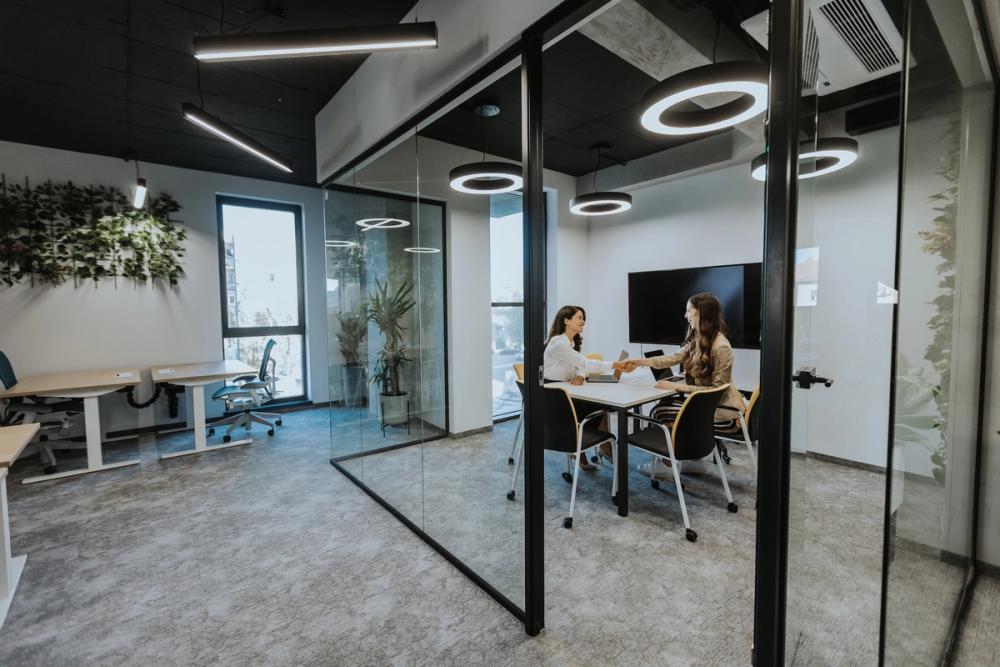
- New partitions change travel distances, sightlines and escape routes. An extinguisher that was visible across an open-plan floor may now sit behind a meeting room wall. Our office partitions include fire-rated systems specified to meet building regulations.
- Mezzanine floors add usable floor area and can count as an extra storey for extinguisher provision. When we install mezzanine floors, we handle the building control submission and any fire protection the structure needs.
- New kitchens, breakout areas and IT rooms introduce Class F and electrical risks that may not have existed before.
- Moving premises means starting the fire safety picture from scratch. Fire points should be part of any office relocation plan rather than an afterthought on moving day.
The same applies beyond the office. An industrial fit out may bring flammable liquids or gases into play, while a retail fit out needs extinguishers that are accessible to staff without cluttering the shop floor.
The best time to think about where fire extinguishers will go is during the design stage. Planning fire points alongside desks, walls and ceilings avoids awkward retrofits and helps your fire risk assessor sign the space off with confidence.
Plan a safer workspace with Fit Interiors
The Responsible Person carries the legal duty for fire safety. Trained staff and fire wardens are the ones who use a fire extinguisher when it is safe. Both depend on a workspace that has been planned with fire safety in mind from the start.
If you are planning an office move, a refurbishment or a full fit out, now is the time to get it right. Fit Interiors has more than 10 years of experience creating commercial interiors across Nottingham, Derby, Leicester, Birmingham and London. From fire-rated partitions to fully signed-off mezzanine floors, we design and build spaces that look great and work hard for the people inside them.
Take the next step today:
- Request a free quote for your fit out or refurbishment project
- Call our team on 0115 812 0009 to talk through your plans
- Email sales@fit-interiors.co.uk and we will reply within one working day
- Browse our case studies to see the spaces we have already transformed